Engagement and Reporting
We’re committed to empowering Queensland’s young people to actively participate and cultivate their futures, while thriving in their communities.
Our young people deserve a seat at the decision-making table and genuine opportunities to work collaboratively with government to create innovative solutions for the issues that impact them now, and into the future.
The following reports will support government, community organisations and decision-makers to better understand what young people are going through and how we can respond in meaningful, timely and effective ways.
We recognise that as time changes, so do the most important issues young people face. For that reason, we are dedicated to creating reports that provide valuable insights into the lived experiences, perspectives, priorities and ideas of young people across Queensland.
If you are a young person (aged 12–25) and wish to contribute to the reports, please complete our Speak OUT survey to share your views and help shape future government policies and programs.
Young Queenslanders Sentiment Report
The 2024–25 Young Queenslanders Sentiment Report 3.4 MB) is an insight into the lived realities, priorities and expectations of young people across Queensland in 2024–25. It represents a range of young people’s voices, reflecting their diversity and complexity.
It is designed to help government, community organisations and decision-makers better understand what young people are going through and how we can respond in meaningful, timely and effective ways.
The top issues of the 2024–25 Sentiment Report were:
- Mental health and wellbeing including support services.
- Education and training including accessibility and financial assistance.
- Physical health including nutrition, accessibility and active living.
- Life skills including the transition to adulthood and emotional intelligence for resilience.
- Cost of living including employment and affordability.
Young Queenslanders Annual Highlights Report
The 2024 Young Queenslanders Highlights Report showcases the progress and achievements we’ve made in delivering on the priorities raised by young people across Queensland.
Through targeted initiatives, we’re working towards a future where young Queenslanders are living their best lives by actively participating and shaping our communities.
Find out how we’re creating opportunities for real, measurable change from the 2024 Young Queenslanders Strategy Highlights 2.9 MB) .
Young Queenslanders Consultation Report 2022
To address the evolving challenges faced by young people, we conducted a statewide consultation between mid-October and late November 2022.
Over 3,200 young Queenslanders from diverse backgrounds participated, sharing their experiences and perspectives through social media and in-person workshops. The consultation aimed to identify key issues, needed services, and ways the government can improve its connection with young people.
The findings outlined in the Consultation Report 2.4 MB) 2.1 MB) combine both quantitative and qualitative analyses from various feedback channels, alongside data from sources like the 2021 ABS Census. It offers a comprehensive overview of key findings and common themes from the 2022 consultation for the Young Queenslanders Strategy.
The Consultation Report also reflects our commitment to youth advocacy in government processes, decisions, and initiatives.
In Queensland, a young person means someone who is between the ages of 12 to 25 years old.
In the 2021 Census, there were approximately 911,158 young people living in Queensland. This means that nearly 1 in 5 Queenslanders is a young person.
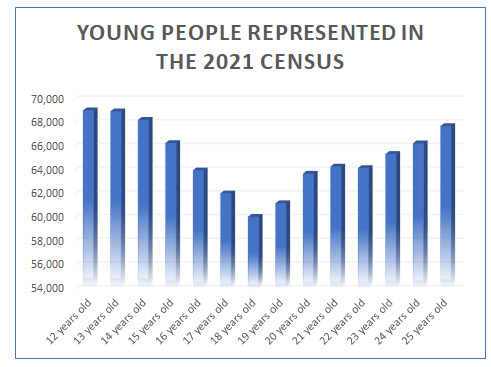
Of Queensland’s young people at the 2021 Census:
- 69,031 were 12 years old; 68,947 were 13 years old; 68,230 were 14 years old; 66,267 were 15 years old; 63,972 were 16 years old; 62,030 were 17 years old; 60,048 were 18 years old; 61,190 were 19 years old; 63,685 were 20 years old; 64,289 were 21 years old; 64,163 were 22 years old; 65,347 were 23 years old; 66,251 were 24 years old; 67,706 were 25 years old
- 7% identify as Aboriginal and/or Torres Strait Islander
- 18% use a language other than English at home
- 3.8% provided unpaid carer assistance to a person with a disability or health condition
- 3.3% are parents and of these parents 29.4% are men and 70.6% are women
- 6.1% provided unpaid child care
- 1.2% have experience of out-of-home care
- 0.6% were having experience of homelessness
- in the youth justice system:
- The number of 10–17-year-old young people who commit offences has decreased by 20% in the past five years. In 2022–23, there were 46,388 proven offences committed by 3,398 individual young people aged between 10-17 years (0.6% of all young people in Queensland). Data from 2023 showed that 43% of young people who have a finalised court appearance never return to the Youth Justice System
- in the adult justice system:
- 1.1% have had contact with Queensland Corrective Services
- of the Queenslanders who were active participants in the National Disability Insurance Scheme (NDIS), 37,975, or 27.4% were young people. This means 4.2% of young Queenslanders were active participants in the NDIS.
In the 2021 Census, over 237,000 people identified as Aboriginal and/or Torres Strait Islander in Queensland – representing 4.6% of Queensland’s population. Notably, more than 128,100 (or over 50%) of Queensland’s First Nations peoples are aged 25 or younger. Within this group, over 64,600 are young people between the ages of 12-25.
This means that over 1 in 4 First Nations Queenslanders is a young person.
Young First Nations Queenslanders feel a significant responsibility in influencing and contributing to the growth, development, and cultural richness of our state.
Of Queensland’s First Nations young people at the 2021 Census:
- 7.6% use an Aboriginal and/or Torres Strait Islander Language at home
- 5.4% provided unpaid carer assistance to a person with a disability or health condition
- 7.4% are parents: of these parents 27.8% are men and 72.2% are women
- 12.6% provided unpaid child care
- 3.3% have experience of out-of-home care
- 2.2% were having experience of homelessness
- in the adult justice system:
- 5.9% have had contact with Queensland Corrective Services
- of the 4.2% of young Queenslanders on NDIS, 4,353, or 11.4% were Aboriginal and/or Torres Strait Islander.