Meet Brett—Queensland Homicide Victims' Support Group CEO
It's Queensland Law Week—and this year we're recognising the people powering justice across our state.
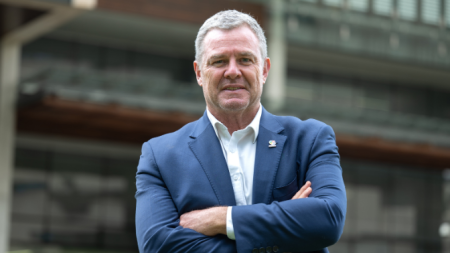
One of those is Brett Thompson, CEO of the Queensland Homicide Victims' Support Group (QHVSG), an organisation that has supported families bereaved by homicide since 1995, with the help of a small team of paid staff and more than 70 volunteers.
But before Brett became a CEO he was a teacher as well as a volunteer ambulance officer on a small island in the South Pacific.
Norfolk Island
Brett spent 10 years teaching on Norfolk Island, and 9 of those as a volunteer ambulance officer. It's where he first saw, up close, what homicide does to a community.
‘It was tragic set of circumstances on so many levels,’ he says. ‘But because you've got such a small community who are very tight, very close—to see a beautiful place so impacted in so many ways was something that sticks with you. I wanted to be able to do more.’
What stayed with him from the ambulance years wasn't just the loss. It was the experience of being able to provide something—calm, hope, safety—at the worst moment of someone's life.
‘You got to be in a very private moment where someone was in absolute crisis. You got to be someone who could contribute, who could provide that sense of safety, but also that hope that we're going to get through this and move forward.’
Joining QHVSG
Brett started as CEO of QHVSG in May 2017.
‘I'd seen, certainly in the ambulance work, what grief was. I thought, I'm comfortable in that space. I wanted a leadership role. I wanted to extend myself.’
The core of QHVSG's work, he says, is deceptively simple: listening, and being honest.
The families QHVSG supports are connected—whether they like it or not—to the justice system for the rest of their lives. Trials, parole hearings, appeals, sentencing reviews. These can resurface decades after the original loss.
‘You're talking about people 20, 30, 40 years down the track after their loss. Everything comes flooding back.’
That makes how QHVSG communicates with families critically important.
‘One of the worst things we can do with any of the work around victims of crime is to make promises that simply can't happen. So, it's important that we sensitively present the realities of situations, so people have the opportunity to prepare for that reality.’
The Critical Incident List
When asked what change he's most proud of helping bring about, Brett chooses one—the Critical Incident List. This is a fast-track process in the federal family court system for children whose only legal parent has been incarcerated or lost.
Before the list existed, families in this situation could face months or years of legal processes—and tens of thousands of dollars in fees—simply to secure parenting rights for a surviving relative.
QHVSG advocated for a fast-tracked, triaged process. After a successful pilot, the Critical Incident List is now formally in place across Australia (except for Western Australia), supported by pro bono lawyers.
Interim parenting orders can now be in place within seven days. The full process can be completed within 28.
‘If nothing else has been achieved in my lifetime in terms of my career, then I guess I can be happy with that.’
The grassroots of advocacy
For Brett, the most important thing about QHVSG's advocacy is that it always starts with the families themselves.
‘The justice and the advocacy always starts from the absolute grassroots. It's not us waking up today and going, hey, we're going to change something today. It's: this person was just speaking to me about this. Can we do this in a better way?’
In his 9 years at QHVSG, he can think of almost no stakeholder—police, corrections, the Department of Public Prosecutions, coroners, government—who hasn't been willing to have the conversation.
‘They're prepared to listen and to change.’
‘Worth getting out of bed for’
Asked what he'd say to a Queenslander who wanted to support families bereaved by homicide, Brett's answer is characteristic.
‘Listen.’
‘We aren't experiencing what they're experiencing. Listening to what they need—and then not telling people what they need—is probably a fundamental thing.’
And his own philosophy? ‘If you're not congruent with what you're getting out of bed for, then don't do it. Life is too short.’
He pauses. ‘It's worth getting out of bed for.’
About the Queensland Homicide Victims' Support Group
QHVSG has supported families bereaved by homicide across Queensland since 1995. The organisation provides peer support, court support, after-hours support, advocacy, and a wide range of services—with the help of a small team of paid staff more than 70 volunteers across the state.