R3003—Babinda Swamp Forest Restoration
Fast facts
- Location: Babinda, Wet Tropics
- Proponent: Landscape Ecological Services Pty Ltd
- Duration: 11 years
- Carbon method: Reforestation by Environmental or Mallee Plantings - FullCAM
- Co-benefits
- Great Barrier Reef
- Wetlands
- Threatened ecosystems
- Threatened wildlife
- Native vegetation
- Employment and skills
- Local & Community Benefits
Restoring rainforest in Australia’s wettest landscape
A wetland restoration project in Babinda, Far North Queensland, is re-establishing endangered lowland rainforest—now reduced to fragmented pockets outside of the Daintree National Park. The project will restore habitat for 53 threatened plant and animal species, improve water quality to the Great Barrier Reef and strengthen landscape resilience to flooding.
Babinda Swamp Forest Restoration, funded through the Queensland Government’s Land Restoration Fund, is an 11-year, $1.5 million initiative to restore low-lying wetland vegetation on a former sugarcane property, while generating Australian Carbon Credit Units (ACCUs) and supporting local jobs and skills.
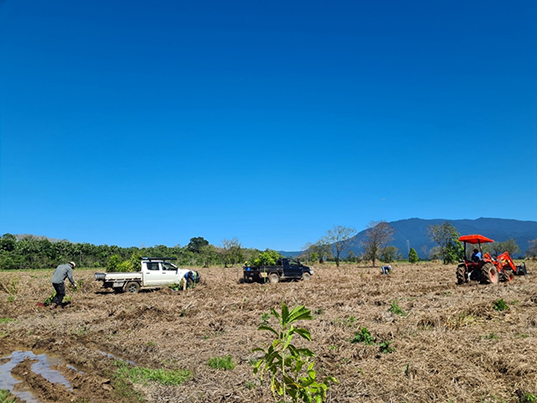
In its second year, 38 hectares of high-diversity rainforest species have been planted, improving habitat for the southern cassowary, spectacled flying-fox and rare rainforest plants such as the erect banana and Russell River Lime, found only in this region.
The site sits at the base of Queensland’s two tallest mountains, Mount Bartle Frere and Mount Bellenden Kerr, receiving more than four metres of rainfall each year. Despite its proximity to mountains, the planting areas sit just two to six metres above sea level, making it highly prone to flooding and tidal backflow. These conditions present both opportunities and challenges for restoration.
“Standing in the middle of the site and seeing only baby rainforest and the backdrop of Bartle Frere and Bellenden Kerr—shows what’s possible,” said project lead Gabrielle Davidson.
Adapting restoration to a changing climate
The 2024–25 wet season highlighted how climate variability is changing wetland dynamics and challenging traditional restoration approaches.
About half of the 13 hectares of new plantings were lost when seedlings were buried under dense plant litter and mud. Rivers remained above minor flood levels for record lengths of time, and tidal backflow combined with dry-season flooding significantly affected site conditions. In some areas, a difference in ground height of five centimetres determined seedling survival.
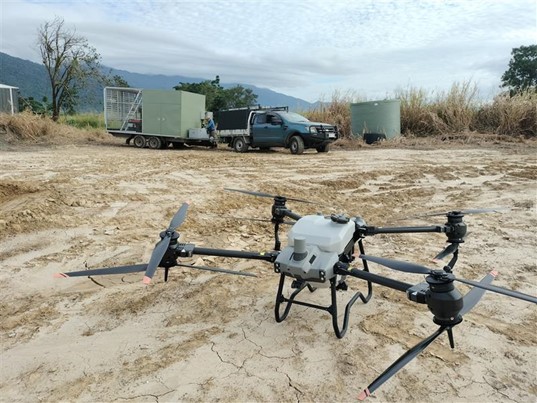
In response, the project team adapted their approach, using detailed microtopography mapping, revised species selection and adjusted planting schedules, to improve seedling resilience.
“Adaptive management must be continuous,” said project lead Gabrielle Davidson. “Restoring dynamic wetlands requires iterative, observation-based decision-making.”
By the following year (2026), these changes—combined with a different type of wet season—were delivering results. In some areas, trees planted less than a year earlier were already more than 4 metres tall.
“This site is difficult to plan for and maintain,” Davidson said, “but when we get it right, the outcome is amazing.”
Delivering environmental and community outcomes
The project is restoring rainforest that once dominated these floodplain wetlands. As the forest regenerates, it will:
- provide habitat for threatened wildlife, including the estuarine crocodile, microbats, freshwater fish, frogs and 40 threatened plant species,
- improve water quality flowing into the Great Barrier Reef catchment, and
- strengthen landscape resilience to flooding and a changing climate.
The project is also delivering strong local benefits. Twenty-six people have worked on site, including TAFE Conservation and Land Management course graduates gaining practical field experience. As their skills developed, several trainees have progressed into higher-level roles. Local nurseries have supplied native seedlings which is supporting regional businesses and helping to build capacity in the local restoration sector.