Tips for buying e-mobility devices
On this page
Check your age eligibility
From 1 July 2026, e-mobility devices and off-road motorbikes cannot be sold to anyone under 16 in Queensland.
This applies to:
- e-bikes
- e-scooters
- e-skateboards
- e-unicycles
- Segways
- electric and petrol-powered off-road motorbikes.
Sellers may ask you for proof of age before completing the sale. This applies to private and commercial sales, including online sales.
Check e-bike labels
E-bikes manufactured after 1 July 2026 must meet the European standard EN 15194 and be permanently labelled as meeting this standard. This standard confirms the e-bike meets key requirements for motor power, motor assistance speed and throttle-only control.
Legal e-bikes in Queensland must not exceed:
- 250 watts of maximum continuous rated power
- 25 km/h motor assistance
- 6 km/h throttle-only control.
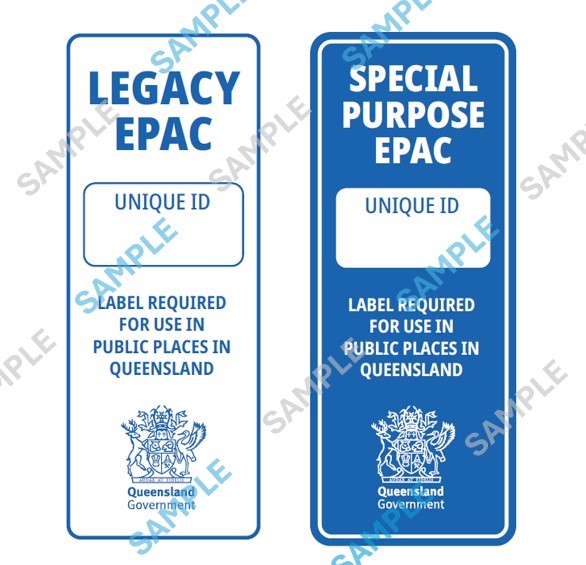
Older e-bikes manufactured before 1 July 2026 may not have an EN 15194 label. Some older e-bikes may have an E-bike Assurance Scheme label instead. This label shows the e-bike has been assessed as meeting Queensland’s requirements.

Watch out for illegal high-powered e-bikes
Some e-bikes sold in Queensland might look like compliant e-bikes, but they are faster and more powerful than allowed. These devices are e-motorbikes and cannot be used in public places.
Watch out for:
- throttle control that can power the bike above 6km/h
- no pedals—if the bike can’t be pedaled, it is not a compliant e-bike
- claims that the bike can be “unlocked” for private property use—compliant e-bikes cannot have their motor outputs changed after manufacture.
- a motor over 250 watts maximum continuous rated power.
If the e-bike has any of these features, it is not a compliant and cannot ridden in public places, like roads, parks and BMX tracks.
You can only ride a prohibited bike on private property, where there is no public access.
Be careful with conversion kits
Conversion kits are not allowed to be fitted to e-bikes made after 1 July 2026.
This means a push bike cannot be converted to a legal e-bike and an existing e-bike cannot be altered by a conversion kit.
This is because e-bikes cannot be certified to meet EN 15194 if they are not tested at the time of manufacture. E-bikes that are altered after they are made, are not compliant with EN 15194.
Conversion kits can still be sold, but bikes fitted with them can only be used on private property, where there is no public access.
Some e-bikes and e-trikes designed for people living with disabilities are subject to different rules. View the rules for Special Purpose EPACs.
Know the limits for e-scooters
E-scooters, e-skateboards, e-unicycles and Segways are personal mobility devices. Personal mobility devices manufactured after 1 July 2026 must:
- be no more than 1,350mm high
- be no more than 750mm wide
- be no more than 1,100mm long, measured between the axles
- weigh no more than 60kg without a rider
- be limited to 25km/h by software or hardware.
Personal mobility devices do not need to be certified to a product standard and do not need a label.
If you purchase a personal mobility device that is not speed limited to 25km/h, take it to your retailer and ask for assistance with setting the limit.
Transition period for faster devices
If you buy a personal mobility device from a retailer or private seller that can travel faster than 25 km/h, you have until 28 February 2027 to have it limited by software or hardware.
Report misleading sales claims
If you're aware of a retailer who might be misleading customers about their products, such as selling high-powered e-bikes as “street legal”, you can take steps to alert the Office of Fair Trading.