Research and initiatives
Crocodiles are shy, well-camouflaged and mobile, which makes them a challenge to study. We take advantage of our regular interaction with crocodiles to run a number of research projects. Knowing more about crocodiles helps us develop tools and strategies to make our work safer and more efficient and provide policymakers and the community with the most accurate information, helping protect Queenslanders from harm.
On this page
Detection and deterrent program
In world-first research, wildlife rangers are examining the way crocodiles communicate through sounds, with early investigations revealing a surprising complexity of vocalisations. The application of this new knowledge could lead to innovative techniques to attract or repel crocodiles.
We are also exploring how using multi-beam sonar technology together with image recognition software can detect crocodiles in an area and alert authorities of their presence. We’re trialling this technology using a clever buoy system, which also records other environmental data (temperature, wind, humidity), to determine when and why crocodiles move into areas frequented by people.
In addition, we’re working with James Cook University (JCU) to develop and test a visual crocodile detection system capable of identifying crocodiles swimming on the water’s surface in both day and night-time conditions. The system’s detection algorithm was developed by JCU researchers using more than 800 hours of footage to train the system to recognise crocodiles. A specialised crocodile monitoring camera mounted on a mobile trailer platform is being used to trial the new technology in crocodile habitats throughout North Queensland.
Privacy collection notice
As part of the crocodile detection and deterrent program, the Department of the Environment, Tourism, Science and Innovation (department) and JCU are testing crocodile detection technology to enhance public safety and support wildlife research and management initiatives.
Specialised crocodile monitoring cameras mounted on mobile trailers are being used in public areas to monitor and detect crocodiles.
A separate CCTV security camera is installed on the mobile trailer to protect it from theft, damage or other unauthorised interference.
The crocodile monitoring cameras and CCTV security cameras may capture personal information, including images or footage, of people in the vicinity of the cameras.
Any collection of personal information captured by these cameras will be handled in accordance with the Environmental Protection Act1994 and the Information Privacy Act 2009.
Use and disclosure of personal information
The personal information collected will only be used for purposes directly related to the detection and deterrent program, including crocodile monitoring activity, supporting public safety and protecting the camera trailer and associated monitoring equipment.
Personal information will only be accessed by authorised staff of the department and JCU.
It may also be accessed by the third-party CCTV service provider, Mobile Camera Security (MCS), where necessary, to investigate suspicious or unlawful activity in the vicinity of the camera trailer and monitoring equipment.
Personal information may also be disclosed to the Queensland Police Service or other law enforcement agencies where required or authorised by law, including in response to a lawful request or to address a public safety concern. The department does not intend to disclose this information to overseas recipients.
Storage and security of personal information
All information collected will be securely stored and managed by the department, JCU and MCS in accordance with the Information Privacy Act 2009. Reasonable steps will be taken to protect the information from loss, unauthorised access, use, modification, or disclosure.
Further information
For more information about how the department handles personal information, including how to seek access to or amend your own personal information, please refer to our Privacy compliance policy or contact the project team directly by email NWResearch@detsi.qld.gov.au.
Crocodile Monitoring Project
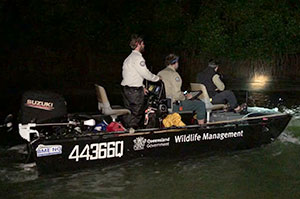
This ongoing study consists of comprehensive vessel and helicopter surveys of north Queensland’s major river systems. It provides a snapshot of the number and biomass of Queensland’s crocodile population and allows us to compare it to previous studies, showing population changes over time. This information helps inform future policy and management actions.
Queensland Estuarine Crocodile Monitoring Program 2016–2019
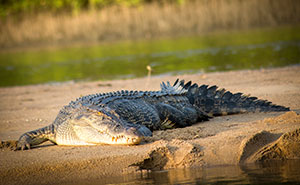
From 2016 to 2019, the department conducted a comprehensive monitoring program of the estuarine crocodile population across its range in Queensland. During 2020, we compiled and analysed data collected through this program and compared these to historic data to assess how the population had changed in size, distribution, density, and size class structure over time–using results collected from as far back as 1979. Further information about this program is available in the key findings report 991.2 KB) and the comprehensive technical report.
Movement and DNA Project
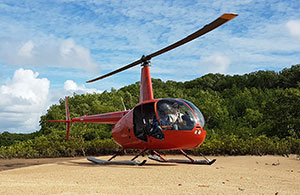
Decades of satellite tracking have given us a solid idea of how crocodiles use and move through river environments, but what about oceans? The department is currently exploring this new frontier of crocodile habitat use by attaching satellite trackers to animals in the Torres Strait.
Wildlife rangers have also been collecting DNA samples from crocodiles and analysing them to determine the relatedness and connectivity of the population in Queensland. These two parts of the project work help paint a picture of crocodile movement in Queensland, and between other populations nearby. The information gathered may directly impact how we manage crocodiles into the future.
Crocodile genetics research report
The genetic structure and connectivity of the estuarine crocodile (Crocodylus porosus) in Queensland 2018–2020 study redefines what is known about estuarine crocodiles in Queensland and more broadly.
Based on over two decades of movement studies, it was believed that estuarine crocodiles could move everywhere and anywhere.
The results of this genetics study have redefined what is known about estuarine crocodiles in Queensland and the species more generally.
It provides an understanding about where crocodiles in Queensland are from (source), where they go (sink), and how far they travel.
This knowledge helps to inform more efficient and effective management and reduce the threat to public safety.
Key facts
- The estuarine crocodile population within Queensland can be described as six sub-populations.
- Most crocodiles remain close to their place of birth with 90% of crocodiles dispersing less than 50km, leading to localised populations.
- There is evidence of historical and recent movement of crocodiles between adjacent sub-populations with connectivity declining with distance.
Find out more
In 2018, the Queensland Government began a long-term project to study the movements of Queensland’s saltwater (estuarine) crocodile population using DNA.
In 2018, the Queensland Government began a long-term project to study the movements of Queensland’s saltwater (estuarine) crocodile population using DNA.
Genetic samples were collected from almost 1200 crocodiles.
The results showed that most Queensland crocodiles remain less than 50km from their birthplace.
That’s different to the Northern Territory population, where almost half of all crocodiles migrate an average of 200km.
We now have a better understanding about localised crocodile populations including where they come from, where they go and how far they travel.
The findings will enable the Queensland Government to more efficiently manage crocodiles and protect the people of Queensland now and into the future.
www.qld.gov.au
Population modelling dynamics study
Modelling population dynamics of estuarine crocodiles on Queensland’s northern populated east coast
In response to the Independent Crocodile Expert Committee’s recommendation to consider removing additional larger crocodiles of more than 2.4 metres in length (recommendation 6), the department commissioned research to undertake further modelling work in relation to estuarine population numbers, specifically in the northern populated east coast (NPEC) region (between Cooktown and Ingham).
Dr Laurence Taplin’s report, Modelling population dynamics of estuarine crocodiles on Queensland’s northern populated east coast, assessed how removing different numbers and ages of crocodiles would impact on the total number of crocodiles in the NPEC area in the long-term.
The population modelling study found that:
- the NPEC crocodile population is not at risk of extinction in the foreseeable future unless there is a significant change in crocodile management practices
- continuing the current rate of removal is likely to be a safe strategy from a species conservation standpoint and as an effective public safety management strategy.
The report’s insights and projections about the NPEC crocodile population and potential impacts on the crocodile populations will help inform options for future approaches to estuarine crocodile management.