“It’s an honour to go over and help and considering it’s a newish capability it’s good to put it to work in an overseas environment,” Mr Herbert said.
Queensland fire officers deployed to Nepal to support disaster response efforts
Two of the Queensland Fire Department’s specialist drone operators are among Australia’s 15-person Disaster Assistance Response Team (DART) joining the international humanitarian efforts in Nepal following August’s tragic flooding event.
Fire officers Dale McVeigh, based at Beenleigh Fire Station, and Matt Herbert who is based at State headquarters, will join colleagues from Fire and Rescue New South Wales as part of AUS-02 DART and will undertake Remotely Piloted Aircraft Systems (RPAS) operations.
Their drone technology expertise will help provide mapping and imaging to support the ongoing efforts of the Nepalese authorities and Matt Herbert said he is pleased to be on board.
“We’ll be deploying as RPAS pilots or drone pilots as they're known, to help assist with the search and rescue or recovery as we have software that can do a lot of mapping and create 3D models.”
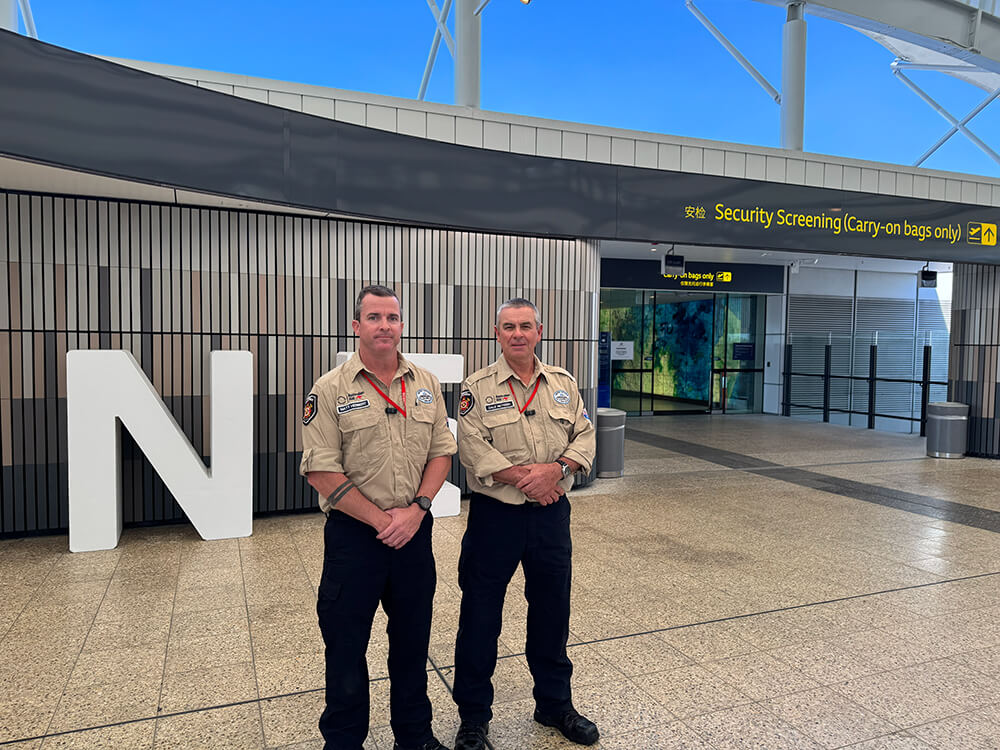 Queensland Fire Department officers Matt Herbert (left) and Dale McVeigh at Brisbane airport before deploying to Nepal.
There are 38 Australians who are unaccounted for following the catastrophe and Australian officials are working closely with authorities in Nepal and China to establish their whereabouts and offer help to their families.
Fire officer Dale McVeigh said he knows the region having been a recent visitor.
“When the event happened, it was devastating news for me because I’ve recently travelled to Nepal through that area and I feel for the people as I have a close connection,” Mr McVeigh said.
The AUS-02 DART deployment is in addition to the 19 Australian personnel who are already in Nepal to support the crisis response, including consular and humanitarian officers.
Fire officer McVeigh thought he and his colleague Matt Herbert would be there for two weeks, at least.
“We would imagine we’ll be there for a minimum of 14 days but that may extend out depending on travel and our requirement.
“If we can continue to help, we’ll stay as long as we need.”
Australians in need of emergency consular assistance should contact DFAT’s Consular Emergency Centre on 1300 555 135, or +61 2 6261 3305 (if calling from overseas).
Australians wishing to donate can visit emergencyaction.org.au.
- Last updated:
- 4 September 2026